

Loan Planning Tool

Personal Loan Calculator for Monthly Estimates

Before you apply, use this personal loan payment calculator to compare personal loans, enter a loan amount, choose a loan term, and see a monthly estimate for illustrative purposes.

Adjusting the numbers takes seconds, and it costs nothing to explore scenarios. The tool is for planning, not a loan offer. Your actual personal loan rate, APRs, fees, maximum loan you can receive, and terms depend on state rules, credit history, creditworthiness, the product you apply for, and the agreement you review if Avio Credit can extend an offer.

Woman using a phone to review loan planning information

Estimate Monthly Costs

Adjust the amount and term to compare a monthly estimate, total amount, and finance charges before you apply.

Loan Amount $2,500
$500$5,000
Loan Term 12 months
3 months24 months
Representative Rate 35.99%

Your actual rate may vary by state, loan product, and borrower profile.

Estimated Monthly Payment
$251.14
Total Amount
$3,013.71
Total Interest Paid
$513.71
Number of Installments
12
These results are estimates, not a loan offer. They use a representative annual percentage rate and your inputs for planning only, and are not a credit decision or TILA disclosure. Your actual rate, fees, amount, term, schedule, and total cost will be shown in your loan agreement before you accept funds. Costs and availability vary by state, product, and borrower profile. Approval is not guaranteed.
Planning Basics

How to Read the Results

Loan amount

The dollar amount you want to borrow. When you enter a loan amount, requesting only the amount you need generally lowers the monthly loan cost and reduces total interest.

Loan term

The number of months over which you would repay the loan. A shorter term can mean a higher regular bill but less total interest. A longer term may lower the monthly figure but increase the overall cost.

Interest rate and APR

The yearly cost as a percentage, including interest and, when applicable, fees. Rates range by state, product, and applicant profile; your agreement explains whether the final rate includes fees and other charges.

Monthly estimate

What a single bill might look like under those inputs. For installment loans, amounts are typically fixed and scheduled on regular dates.

Total paid

The sum of principal and interest payments over the life of the loan. It is different from the amount you borrow and can be easier to review in an amortization schedule.

Total interest and finance charges

The difference between the total paid and the amount financed. This shows the annual cost and dollar cost of borrowing money above the principal.

Start your Avio Credit application now

Complete the secure online form in just a few minutes. Review your actual rate, fees, schedule, and disclosures before you accept any loan agreement.

Start Your Application

How To Use It

Four steps to get a useful estimate

Woman reviewing loan planning information on a smartphone
01

Set the amount.

Start with the amount you actually need, not the maximum available. You can always adjust upward, but beginning with a realistic figure gives you a more useful baseline.

02

Choose a term.

Try a shorter term first to see how the regular bill and total interest compare to a longer one. Both the installment size and the total cost will change.

03

Review the estimate and total cost.

Ask yourself whether the number fits within your regular budget after your other bills and expenses. Also look at the total paid - that's the full cost at that rate.

04

Test smaller amounts and different terms.

If the result looks high, reduce the amount or extend the term to see how each change affects the numbers. Requesting less is usually the fastest way to lower both the installment and the total cost.

Estimate Limits

What this tool can help you do

Useful for planning

  • Estimate whether a particular amount fits your monthly budget
  • Use loan calculators to estimate monthly payments and plan repayment before applying
  • Compare the cost difference between shorter and longer terms
  • Understand roughly how much total interest accrues over the life of a loan at a given rate
  • Use it alongside other financial calculators for personal finance planning, such as a car loan, mortgage, or home equity comparison
  • Decide if taking on debt makes financial sense for your situation right now

Not a final loan offer

  • Guarantee that you'll be approved for any amount
  • Show your actual rate, fees, or terms - those are determined after you apply and are reviewed as part of underwriting
  • Account for state-specific loan maximums, term limits, or fee structures that apply where you live
  • Substitute for reading the actual loan agreement and disclosures that would accompany a real offer
Direct Lender Review

The general process

01

Application

You complete an online application with personal, income, banking, and checking account information. The application is submitted directly to Avio Credit for review.

Secure application checklist shown on a smartphone
02

Review and verification

Avio Credit may review your credit history, income, banking activity, and other application data as part of the underwriting process. The specific factors reviewed can vary by product and state. Submitting an application does not guarantee approval.

Loan verification status shown on a smartphone
03

Loan agreement

If your application meets eligibility criteria and is approved, you'll receive a loan agreement that includes your actual rate, finance charge, amount, schedule, and all fees. Read this document carefully before accepting.
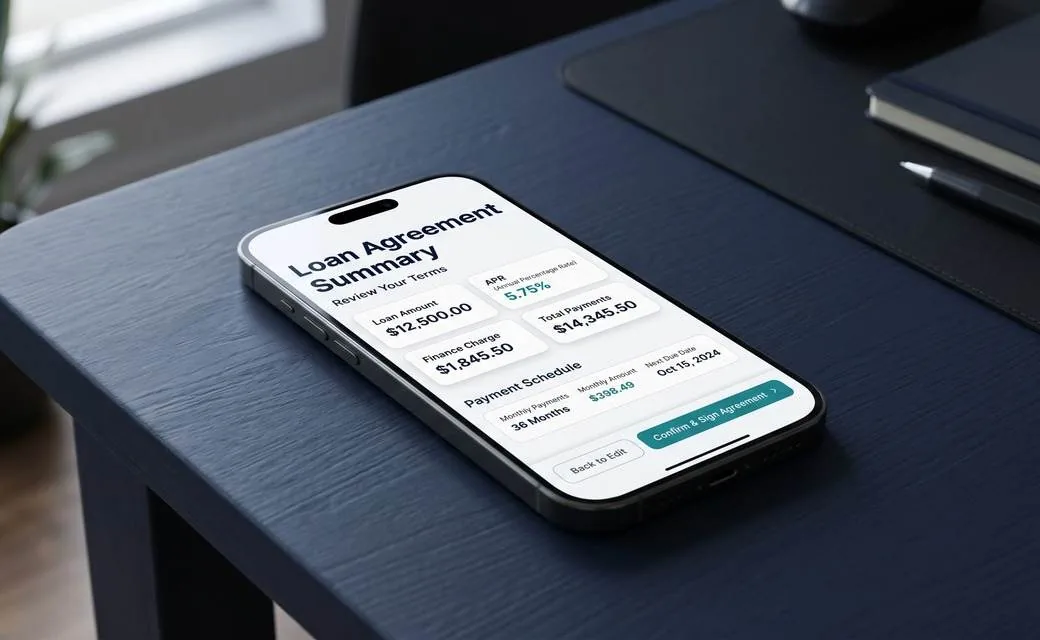
Loan agreement summary shown on a smartphone
04

Funding

For approved borrowers who accept the loan agreement, funds are deposited via ACH to the bank account on file. Funding timing depends on when final approval is completed, your bank's processing schedule, ACH cutoff times, and whether the funding date falls on a weekend or holiday. Funds may be available as soon as the next business day for some approved borrowers, but timing is not guaranteed for everyone.

05

Scheduled debits

Debits are typically scheduled via ACH on dates established in your loan agreement. Keeping your bank account funded on due dates helps avoid returned payment fees and potential negative credit reporting.

For details on basic eligibility and what information you'll need to apply, visit Requirements or How It Works.
Cost and Schedule

Rates, due dates, and payoff choices

Payment date schedule

Due dates and schedule

Your schedule, including each due date and amount, will be set out in your loan agreement. Installment loan amounts are typically fixed and generally collected via ACH from the bank account you provided during the application.

Review your due dates against your pay schedule before accepting. If the dates do not align well with when you receive income, contact Avio Credit support before accepting the loan to understand your options.

Principal$2,500
Finance charge$513.71
Total paid$3,013.71
Finance charge planning

Rates and finance charges

APR expresses the yearly cost as a single percentage, making it easier to compare loan options. For short-term and small-dollar loans, the percentage can appear high even when the total dollar cost is modest, because the payoff period is short.

Before accepting any loan, compare the rate and the total finance charge - the actual dollar amount you'll pay above the principal. Rates, fees, and available amounts vary by state, product, and borrower profile. Exact costs are disclosed in your loan agreement before funding.

Payoff and payment support

Early payoff and missed payments

Paying off your loan ahead of schedule may reduce the total interest you pay. Whether early payoff is permitted without penalty depends on your loan agreement and state law, so check your agreement for any prepayment terms.

If a scheduled debit cannot be collected because of insufficient funds, a closed account, or another reason, you may be charged a returned payment fee or late fee. Delinquent accounts may be reported to consumer reporting agencies, and persistent non-payment may result in collection activity and additional costs.

If you anticipate difficulty with an upcoming debit, contact us before the due date. Early communication gives you more options.

Responsible Use

Budget Checklist

Borrow only what you need.

Request only the amount necessary to cover the immediate need. Matching the amount you need to clear financial goals can help keep the total interest lower.

Confirm the estimate fits your budget.

Add the estimate to fixed expenses like rent, utilities, insurance, and credit card debt. If the total strains your income, consider a smaller loan or another option.

Consider how long the schedule lasts.

A longer term reduces the monthly figure but increases the total amount you'll pay. Make sure you can make payments across the full timeline, not just the first due date.

Look at alternatives first.

Depending on your situation, other options may cost less: an arrangement with a creditor, an employer payroll advance, a credit union loan, a secured credit card, or assistance programs in your area. Visit Alternatives to see a broader list.

Read the loan agreement fully before accepting.

Once you accept a loan offer and funds are disbursed, you are responsible for the terms as written. Review the rate, finance charge, schedule, and all fee disclosures before you click accept.

Questions

Loan Calculator FAQs

No. This educational tool uses a representative rate and the inputs you enter to produce estimated figures. It does not access your application data, credit profile, or state-specific pricing. Your actual amount, rate, fees, and terms are determined during the underwriting process and disclosed in a written loan agreement before you accept any funds.
Using the loan payment calculator does not trigger any credit inquiry and has no effect on your credit score. A credit review may occur if and when you submit a formal application, and lenders use credit report, income, and identity information to evaluate creditworthiness.
APR is influenced by several factors: the loan product you apply for, the term, your requested amount, your credit profile, your income, and state law. States set their own rules on allowable rates, fees, and loan structures for small-dollar loans. Because these variables differ for every applicant, a single fixed rate does not apply to everyone. The rate shown here is representative and used for illustration only.
No. Using this tool is not an application, and it does not generate any approval decision. Approval is not guaranteed for any borrower. Submitting an application starts the review process, and Avio Credit evaluates each application based on eligibility criteria, credit and income information, and state availability before making a decision.
For a standard fixed-rate installment loan, your scheduled amount is set at the time you accept the loan agreement and does not change during the term. Your loan agreement will state all amounts and due dates. If you have a line of credit product, required amounts may vary depending on your outstanding balance. Review your specific agreement to understand how payments are structured.
Funding timing depends on when final approval is completed, when you accept the loan agreement, your bank's ACH processing schedule, and whether the funding date falls on a weekend or federal holiday. For some approved borrowers, funds may be deposited as soon as the next business day. Timing is not guaranteed for all applicants or under all circumstances. Submitting your application early in the business day may help, but it does not guarantee same-day or next-day funding.
Try reducing the amount or, if your timeline allows, lengthening the term to see how both changes affect the estimate. If no scenario comfortably fits your budget, it may be worth reviewing alternatives before applying. Taking on more debt than your budget can support is one of the most common reasons borrowers run into difficulty.
Yes. A calculator can help you compare scenarios before you refinance, get a personal loan, or review offers from many lenders. Compare the personal loan rate, total cost, terms, and whether a lender may charge fees. Borrowers with excellent credit may see different options than borrowers with limited or damaged credit.
This planning estimate uses a representative rate and does not separately model an origination fee. If an origination charge or another fee applies, it will be disclosed in your loan agreement before you accept funds.
It shows the estimated total paid and total interest paid, which helps you understand the finance charge at a summary level. It is not a full amortization schedule, so it does not break out each month separately.
The page is designed for unsecured personal loan planning, but the same general math can help you think through other examples. Secured products, a car loan, a mortgage, home equity borrowing, or a line of credit may use different fees, terms, and payment rules.